
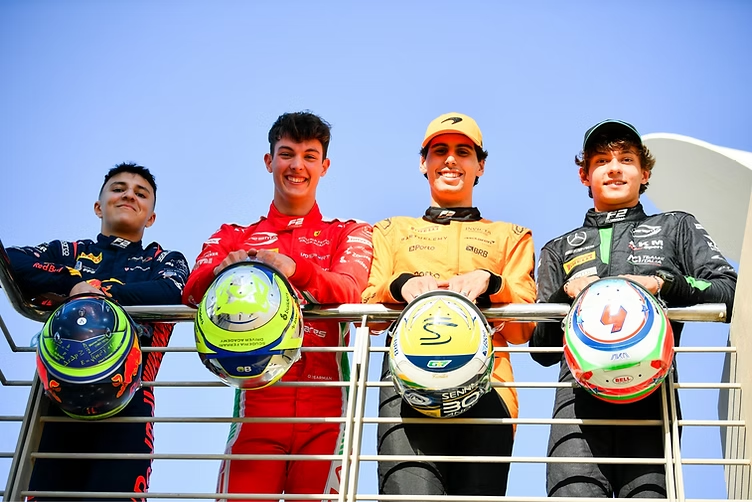
Lately, we’ve been hearing a lot about Driver Academy or Junior Academy. In this article, we analyze in detail how they’re organized, what they offer, and how they help young people, but above all, whether or not they’re crucial to drivers’ careers.
Academy drivers are development programs created by official teams, both in Formula 1 and other categories. They spot young motorsport talents, training and preparing them for a professional career, which could be in Formula 1, the WEC or other minor championships.
They are a real growth path, where the selected pilots receive technical, physical and mental support. Academies’ goal for their drivers is to get them started on what it really means to be a motorsport professional. They provide everything a real driver needs: athletic preparation, driving coaching, nutrition, engineer support, simulators, and track experiences with select cars. Obviously, they also offer important financial support, which to date has become the fundamental part for a young person, if not the most significant. Entire seasons of championships such as Formula 4, Formula Regional, but also the karts themselves, are very expensive.
Clearly, the primary goal of teams in developing their academies is to secure future talent who can one day bring significant success. This is a real investment by the teams for their future success.
All the major Formula 1 teams have their academies, from Ferrari to Mercedes, from McLaren to Red Bull, but also Aston Martin and Alpine. Let’s find out the main ones.
Scuderia Ferrari Driver Academy
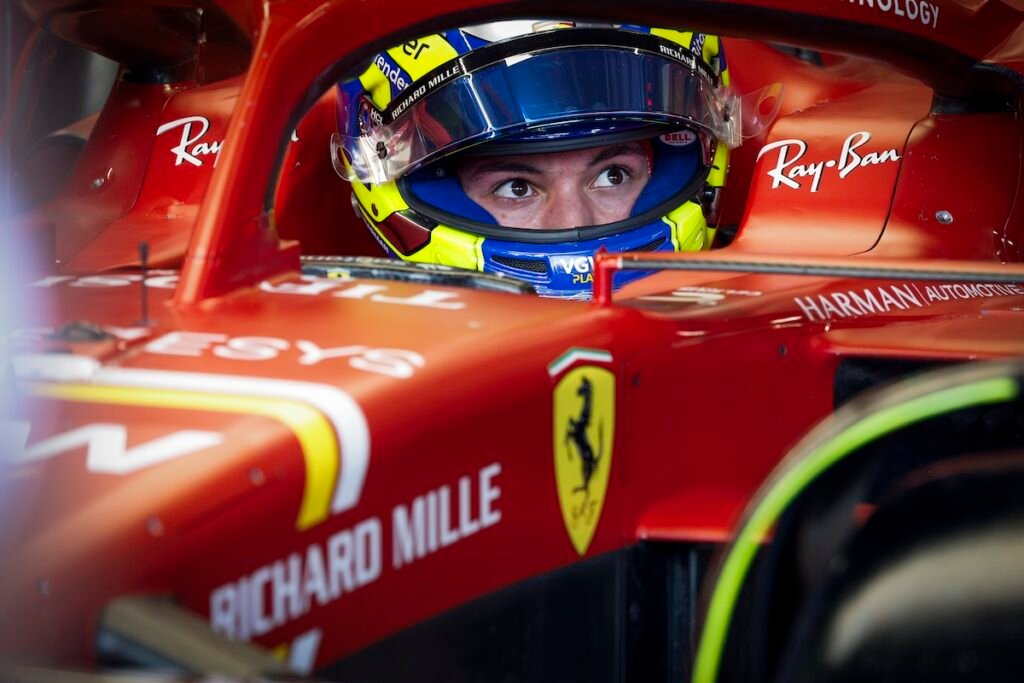
The Italian team’s academy is one of the most sought-after and followed in all of motorsport. The first example is certainly Charles Leclerc, who grew up with Ferrari from the lower categories, before arriving in Formula 1. In his first year he made his F1 debut with Alfa Romeo and subsequently landed in the Prancing Horse team. Leclerc’s talent over these 7 years in red has made everyone understand why Ferrari has been set on him since he was very young.
Another example but in a different category, namely in the WEC, is Antonio Fuoco. He also grew up in the team’s academy, competing in all the minor formulas. But, unlike Leclerc, it has found its dimension in the World Endurance Championship, thanks to Ferrari’s return to the championship’s parent category, winning the 24 Hours of Le Mans in 2024 and, a few weeks ago, the 2025 Constructors’ World Championship.
Oliver Bearman, on the other hand, is the latest “pupil” of the Ferrari Academy. Born in 2005, which has just concluded its first year of Formula 1 with Haas, but with the support of the Scuderia Ferrari Driver Academy. In his rookie year in F1 he showed why Ferrari put a lot of emphasis on the British driver. Given his talent, many imagine him as Hamilton’s natural successor at Ferrari in 2027, should the seven-time world champion leave.
In addition to the above, there are also many other youngsters who are making their mark in the lower categories. Such as Dino Beganovic in Formula 2, the new 2025 Formula 3 champion Rafael Camara and the Finn Tuukka Taponen.
Ferrari is also focusing heavily on women, first and foremost Maya Weug, who has just finished the F1 Academy season competing for the title until the final race. Along with her, Brazilian Aurelia Nobels and new team entry Alba Larsen, also competing in the F1 Academy.
Mercedes Junior Team
Mercedes is another important team that invests in the youth development program, and in recent years several drivers have arrived in F1 from the German team’s academy. Esteban Ocon, now in Haas, was one of the first, along with Pascal Wehrlein, to make his debut in the major championship thanks to the growth he had in Mercedes’ junior programme. The most recent examples, however, are the current drivers of the F1 team, namely George Russell and Andrea Kimi Antonelli, demonstrating how much the team believes in its youth development program.
Redbull junior team drivers
Red Bull was perhaps the first of the major F1 teams to invest in and establish its own driver development program. Over the years, many young people from the academy have reached the major categories, but, obviously, the most iconic is certainly Max Verstappen. The “Dutch lion” needs no introduction, his winning career speaks for him. He joined the red Bull Junior Team in 2014, making his F1 debut the following year with Toro Rosso, RB’s secondary team, at just 17 years old. In 2016 he immediately moved to the factory Red Bull F1 team and that same year, at the age of 18, he achieved his first victory, becoming the youngest driver ever to win a Formula 1 race. From then on the rest is history.
A driver who, after making his Formula 1 debut, has found success in other categories is the Swiss Sebastien Buemi. Formula E world champion in 2016 and four-time winner of the 24 Hours of Le Mans, and four WEC championships.
Another great driver who grew up with Red Bull is 4-time Formula 1 world champion Sebastian Vettel, who won all his world championships with the Austrian team.
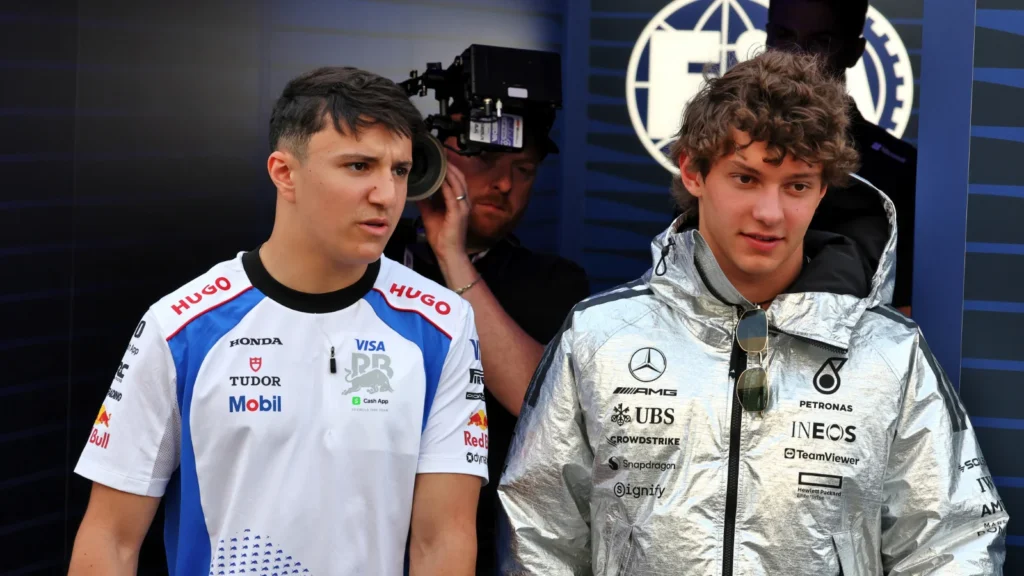
The latest examples of the Red Bull Academy are the current F1 drivers. Isack Hadjar, promoted to Red Bull for the 2026 season, Liam Lawson to Racing Bulls and his future teammate for the 2026 season Arvid Lindblad. Yuki Tsunoda, making way for Hadjar in RB, will be the team’s third driver and test driver.
Red Bull is also present in the F1 Academy supporting Chloe Chambers and Alisha Palmowski.
The entire Red Bull youth project was led by “superconsultant” Helmut Marko, who announced his retirement from racing at the age of 82 at the end of the 2025 F1 season. All these drivers are his legacy to Red Bull and all motorsport.
McLaren Driver Development Programme
Over the last couple of years, McLaren has put a lot of focus into growing its young driver development schemes, a decision that was probably influenced by the team’s remarkable Formula 1 results.
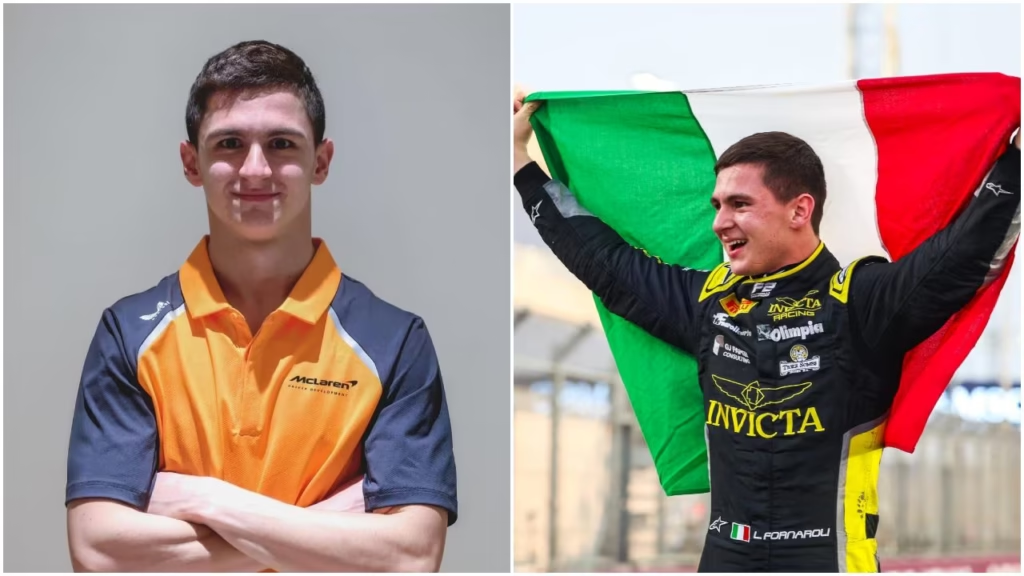
This program’s most prominent driver is undoubtedly newly-elect F1 world champion Lando Norris. The newest member is also a world champion – Italian driver Leonardo Fornaroli joined the papaya ranks in 2025, shortly after clenching the Formula 2 title in his rookie season in the series and only a year after he had won the same title in Formula 3. Fornaroli will be the third driver, taking on a development role and hoping to jump into one of the two McLaren’s, even though his eyes remain set on a 2027 WEC debut in Hypercars.
As female drivers finally become more frequent across all motorsport grids. McLaren is supporting 20-years-old F1 Academy driver Ella Lloyd, who was also the first woman to join the British team’s junior roster in 2025.
Other current papaya feeder series drivers include three 2025 Formula 3 competitors. Italian driver Brando Badoer, Martinius Stenshorne and Ugo Ugochukwu all prove McLaren’s commitment to invest in young talents and support them on their journey to the pinnacle of motorsport.
So, is being signed to one of these official driver programs essential to make it to the top?
As we have seen in this article, there are many examples of drivers from various academies who have made it to the top championships and even won titles.
Being part of official team programs from an early age is certainly a big advantage. It can be compared to receiving a crash course on the insides of the sport, allowing drivers to get ahead and be fully ready when they join a new championship.
Another important aspect, as previously mentioned, is the financial support that large teams can provide with these programs. Competing in feeder series and karting is incredibly expensive, families often can’t bear the cost and risk having to give up their children’s careers and dreams early on.
But some drivers have made it without the official backing of any major teams and their programs. Although now formally part of the papaya ranks. Leonardo Fornaroli took home the driver’s championship trophy in both Formula 2 and Formula 3 on back-to-back seasons before he was affiliated to a Formula 1 team’s program. Charles Leclerc, George Russell and Oscar Piastri are three more drivers who can boast having reached the top of the standings on consecutive seasons in F2 and F3, but all of them were part of junior academies. The fact that Fornaroli achieved the same result without the help of an official development program makes it even more impressive and was probably part of the reason behind McLaren’s decision to sign him on as third driver for the 2026 F1 season.
–
Brazilian driver Felipe Drugovich, in a way, had a similar journey and can be considered Fornaroli’s predecessor. Drugovich won several championships in youth series, like Formula 2000, Euroformula Open and Spanish F3 in 2018. In 2022 he took home the F2 title, all without ever being supported by an official program. In 2023, Aston Martin then picked him up as the first driver in its new academy and the team’s development driver. Unfortunately Drugovich never quite had the chance for a full-time F1 role. Aston Martin let him behind the wheel in a few free practice sessions and some official test days, until he left the team altogether at the end of the 2025 season to pursue a new opportunity as a Formula E driver with Andretti in 2026.
In summary, the answer is: yes, it is possible to make it to F1 without a team’s backing. In this case it is even more essential, though, to have outstanding results that can showcase a driver’s talent. Those that get the chance to grow and get experience across years within a driver development program undoubtedly have the edge.