
On February 27, 2026, we attended an intriguing meeting organized by Pro Loco Marcallo con Casone (MI) in collaboration with Gruppo Fontana Auto. Our hosts on this occasion were Giancarlo Bruno, an engineer, and the famous Ivan Capelli. The first tried to shed light on the new 2026 F1 regulations, while the second talked about his career, also presenting his new book “Quella volta che…“
Giancarlo Bruno – new 2026 F1 regulations
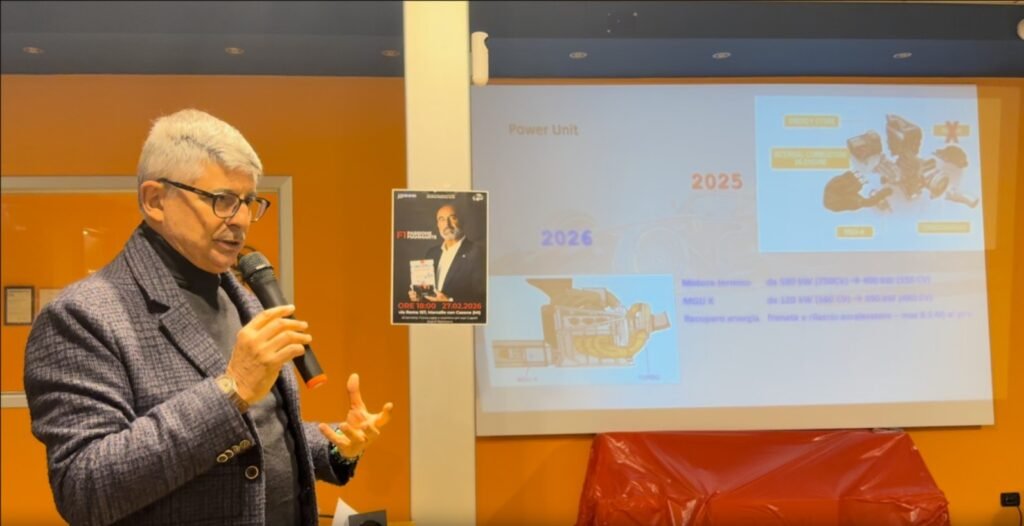
The engineer commences his speech by stating that the changes are extremely complicated. After the tests done in Bahrain, the FIA is considering making further changes to solve the issues.
Regarding technical innovations, let’s talk about the dimensions of the cars. Until 2025, the mass of F1s could reach 798 kg. The FIA decided to make a change this year, noting that the cars had become too large. There is therefore an intervention on the weight of 30 kg, in order to make the vehicles less bulky and more agile.
A second intervention was made on the aerodynamic aspect. This year we’re seeing active aerodynamics. We have two defined modes: corner mode and straight mode. Let’s start with corner mode: when the car is cornering, you need to have maximum downforce, so the front flap and rear wing must be in a position that generates more load, so that cars cornering are faster. Straight mode: The front flap and rear wing open (opening reduces pressure, resulting in higher speed). Concerning this aspect, the real innovation was made by Ferrari, whose cars have a flap that can make a complete rotation – as seen during the tests.
Giancarlo goes on to outline the technical rules. This year the bottom of the car changes. It becomes flat – until last year there was a part of the bottom that gave some load – helping to reduce downforce. The latter will be 30% less than in previous years, the cars will therefore be slower in corners. While the forward resistance will be 40% lower, making the cars faster on straights. Despite this, it is still necessary to carefully analyze whether these two aspects manage to balance each other.
We also have changes regarding the tires. The front ones will be a little narrower and will have a slightly different radius than the past ones. Having about 25 mm less, it means, however, that there will be less mechanical adhesion. For the rear ones, however, the difference is 30 mm. The compounds will remain the ones we are used to, that is, soft, medium and hard.
Let’s move on to power units. Here we mean the complex provided by the heat engine and electric motors. Until 2025, there was a combustion engine, a turbocharger, the MGU-K (Motor Generator Unit – Kinetic) which takes energy from the braking release and sends it to the battery, the MGU-H (Motor Generator Unit – Heat) where the exhaust gas serves to generate energy which is then sent to the battery. This year the MGU-H will be removed. In addition, the internal combustion engine was depowered, from 750 hp to 550 hp, and to balance it, the MGU-K electric motor went from 160 hp to 480 hp. The total power has increased, but the problem is that due to a technical limitation, the electrical part cannot fully charge. A solution will therefore have to be found.
The fuel, which until last season was E10, has now become totally sustainable. This does not mean that it is a bio-product, but a synthetic blend. In addition, in past years the tank had a defined limit of 110 kg of fuel, now this is no longer in the regulations.
Another new feature will be the overtaking mode. This will be activated by the pilot in certain parts of the track under the FIA’s control. The problem always remains one: if the engine has failed to recover a large amount of energy, the driver can press the boost button but the overtaking will not be completed.
Ivan’s comments after Bahrain’s tests
The most commonly used word to describe the drivers’ feeling with the car is “unnatural.” They have a lot more to keep track of and listen to on the radio. Furthermore, by failing to obtain enough energy, the driver is forced to do much more work; even for example, by making more use of the so-called “lift and coast”-when on the straight you lift your foot from the accelerator before the corner to save fuel and recharge the battery. All teams and all drivers have pointed out this problem.
Ivan paints a further dilemma for us regarding starts. By eliminating the MGU-H, the “turbo lag” returns, that is, a delay between the moment the accelerator is pressed and the arrival of the power increase provided by the turbo. In Bahrain, many cars were seen where the driver would stand still for about 10 seconds with his foot on the accelerator, then finally lift it up and start after the turbo power revived. In the second test session, after realizing the problem, they introduced an additional starting procedure. Not having enough time to get the turbo up to speed, there will be a prestart (blue light) that will last 5 seconds before the traditional red lights come on.
Despite this, everyone found good reliability of the cars.
“Quella volta che…”
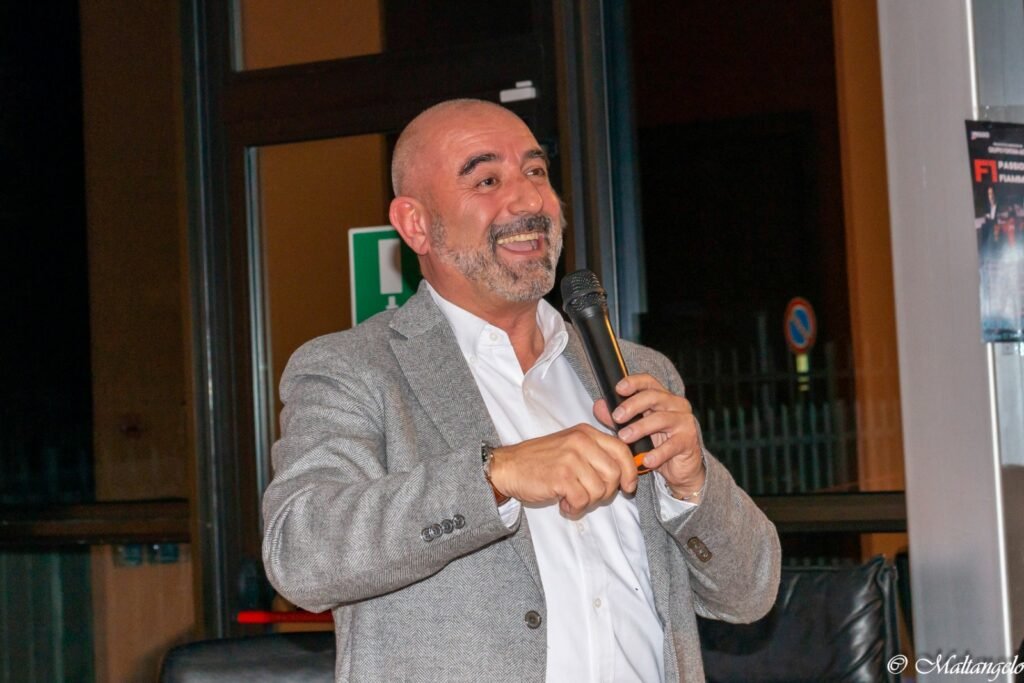
Ivan seizes this opportunity to introduce us to his book: “Quella volta che…” (G. Nada Editore). He shared with us brief anecdotes regarding his life and career that have remained with him to this day.
In 1985 he took part in the Formula 3000 championship. He then joined a lunch organized by the Italian Journalists’ Association, which was also attended by Enzo Ferrari. He talks about how Ferrari made him sit next to him to ask him about his plans for the following year. His dream is to get to F1, but the problem was the money, so it would have been easier to go to America. Ferrari reveals how team managers look more at European races and advises him to stay. The Commander says one last thing: to call him at the end of the season. That moment comes, and Ivan is convinced that Ferrari had forgotten. However, the situation was the opposite: he remembered perfectly and assures Capelli that, having decided to race in Europe, they would keep an eye on his races. One can easily imagine the emotion of a young pilot.
After sharing some iconic moments of his career, Ivan then tells us how he has always adapted and reinvented himself throughout his working life. It was 1997 when journalist Oscar Orefici called him and told him how Telepiù was starting a new adventure in F1. Knowing that Ivan was without a seat at the time, he asks him if he wanted to try giving a shot at commentary. After a very brief rehearsal-commentary in the television studios he signed the contract and became a commentator. He then signed with Rai in 1998 where he worked for 20 years before being hired by Sky after a short break.