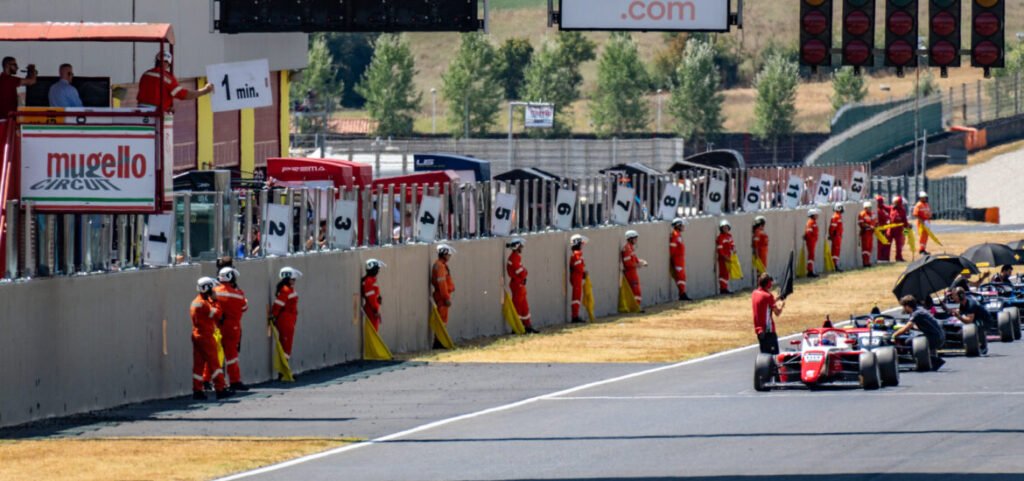
We always see them trackside, ready to step in when there’s an accident. Let’s find out who they are, what they do and how to become a circuit marshal.
They rarely get a mention, yet they are essential to every motorsport event. A marshal’s life is made up of responsibility, total focus on the action on track, dawn starts and entire days spent at trackside posts. We’ll look in detail at what being a marshal means and, finally, follow a typical day for one of them at the Ferrari Historic GP, held at Mugello Circuit over the weekend of 2–4 October.
First things first: how do you become a track marshal?
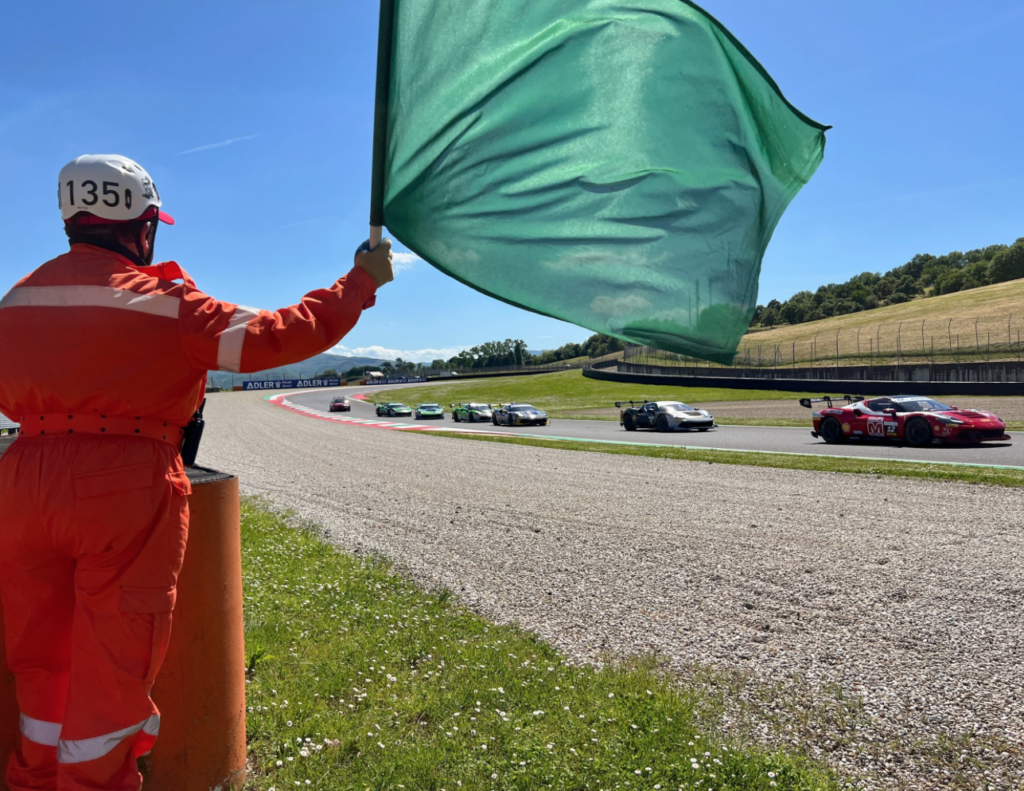
The first question every enthusiast interested in becoming a marshal asks is simply this: how do I go about it?
The Florence Race Officials Association (Associazione Ufficiali di Gara di Firenze), in collaboration with ACI Firenze and Motoclub Firenze, for example, runs courses to train new track marshals in the press room of the Mugello circuit. Two courses are held each year, one for cars and one for motorcycles. Each participant goes through theoretical and practical training, followed by tests to check what they have learned. Once you have passed the tests, you are licensed as an FMI (Italian Motorcycling Federation) Track Official for motorcycles and an ACI Sport Track Marshal for cars. From that point on, you can serve anywhere in Italy by applying to individual circuits or to local associations in the relevant areas.
You can also serve outside Italy, with special authorization from ACI Sport or the FMI.
The importance of this role
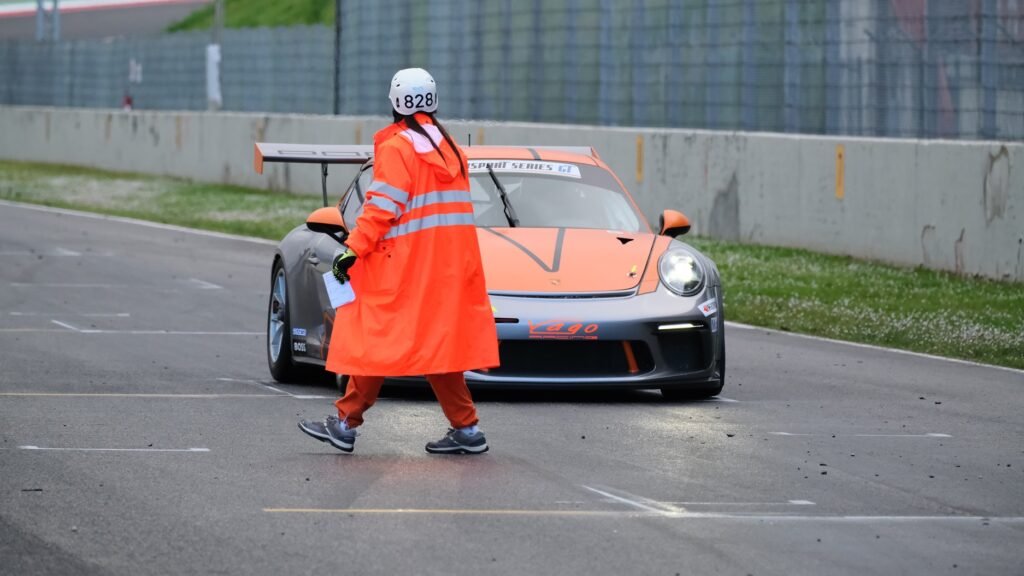
Let’s now look at why a marshal’s job isn’t just about recovering cars or bikes after a crash. On TV, we’re used to seeing them step in only to clear drivers and vehicles from the track, but their job is not just that. A track marshal, in fact, is involved in every “phase” of an incident. Let’s take an example.
When a bike or a car ends up in the run-off area, the marshal must pay close attention to what is happening and promptly warn oncoming drivers and riders of the danger, for their own safety and for that of the competitor involved. A delay of even a few seconds in displaying the proper signals can have dangerous consequences. This shows just how much responsibility every marshal around the circuit carries.
Beyond accidents, the marshal’s job is to inform race control of everything that happens on track. Examples include unsporting behaviour by drivers towards their fellow competitors, overtaking under safety car or virtual safety car conditions and, again, any technical problems with the cars.
So we can see that a marshal’s role is not just recovering drivers and vehicles after accidents, but full 360° monitoring of everything that happens on track.
Can anyone become a track marshal?
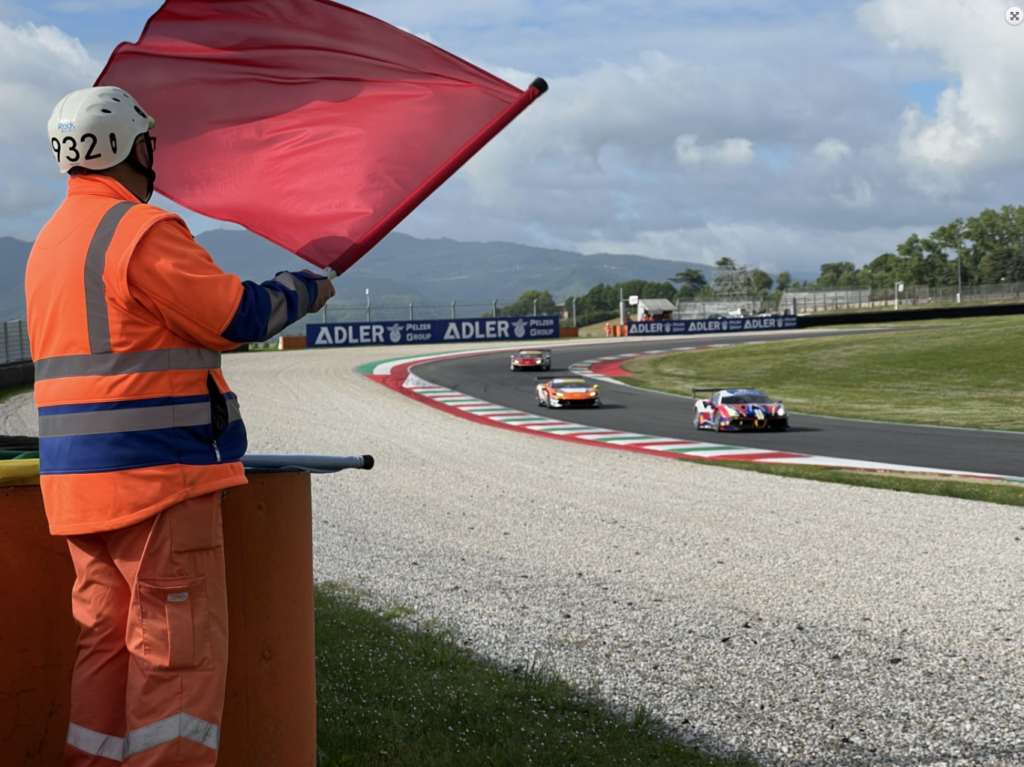
Another question people often ask is whether they meet the requirements to pursue this passion, which demands a commitment comparable to that of a real job. As long as you are between 18 and 75, the answer is, of course, yes. There are, naturally, a few things we need to keep in mind. As we have just said, this is a very important role with equally great responsibilities, which is why it demands the utmost seriousness and dedication. If you think being a marshal is just a way to watch drivers and cars from a privileged vantage point, you couldn’t be more wrong.
So, with those caveats out of the way, anyone with a passion for and respect towards this sport can become a track marshal.
A day as a marshal at the Historic Italian Grand Prix
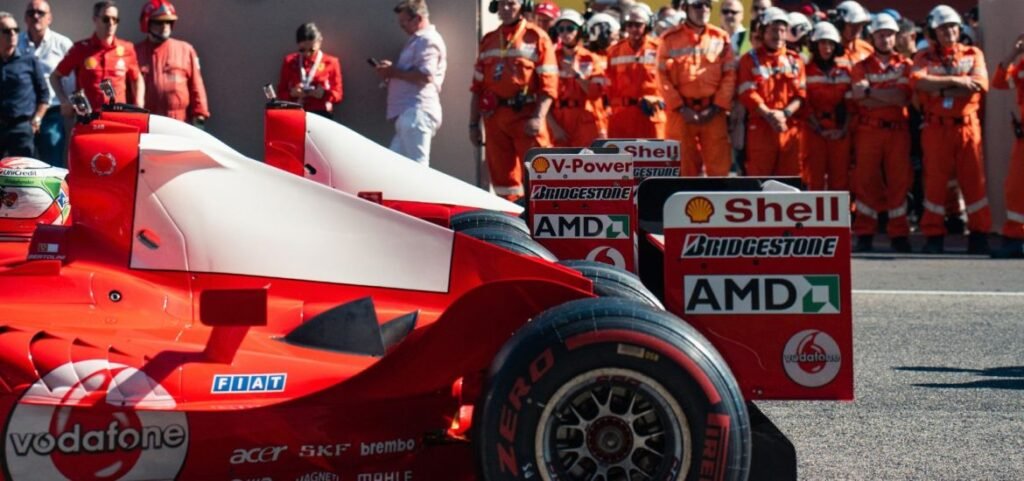
Let’s now go into more detail and see how a typical day unfolds for a track marshal. To do so, we’ll use the Historic Italian Grand Prix, held at Mugello to celebrate Michael Schumacher’s golden years with the Maranello team.
Over the three days of the event, more than 200 cars took to the track, split into several categories, including historic F2 and F3 cars and F1 cars from the 1980s to the present day. The most anticipated moment was the “Golden Age Ferrari” demonstration, in which as many as 10 Ferrari single-seaters let everyone present relive the fabulous winning years of the “Rossa”.
Now let’s see what a marshal’s typical day looks like at this event. It starts very early. As mentioned, more than 200 cars will take to the track, which means many hours of action, from morning until sunset. Each marshal must therefore report to their post at the time set by race control. Each corner can have one or more posts dedicated to marshals. Once at their post, there are several tasks to complete even before the cars go out. The first two are checking and cleaning the track and setting up everything needed for signalling, namely flags and boards. After that, everyone prepares for the usual track inspection carried out by race control, which checks that everything is in place and in order, ready for the day that is about to begin.
After the inspection and all the checks, it’s time for action as the cars hit the track. Each marshal has their own job to do: some display flags, others boards, and others must stand ready to recover cars in the event of an accident. Depending on the session, whether qualifying or race, a marshal’s duties can change; let’s see how. During qualifying, for example, the flag marshal must be very careful in displaying signals to drivers, especially blue or white flags.
During races, by contrast, marshals need to be even more alert, especially in the opening laps, to display signals quickly or step in after contact or accidents. In addition, particularly in races, there will be several safety car interventions, and marshals must be ready to signal to drivers both when the SC comes out and when racing resumes. All the activities we have just described make up a marshal’s typical day at this Historic Italian Grand Prix, not forgetting, of course, the recovery of cars that end up in the gravel. Once all the day’s scheduled sessions are over, every marshal must do exactly the opposite of what they did in the morning: put all their “tools of the trade” back in order, ready to be used again the next day.
As you can see, then, the marshal is an essential figure for every kind of speed activity on track. Without them, no race or event of any kind could take place. We hope that this article has helped you better understand the key role of a figure who is all too rarely mentioned. It is thanks to them that all of us motorsport fans get to enjoy what we love most: racing.