
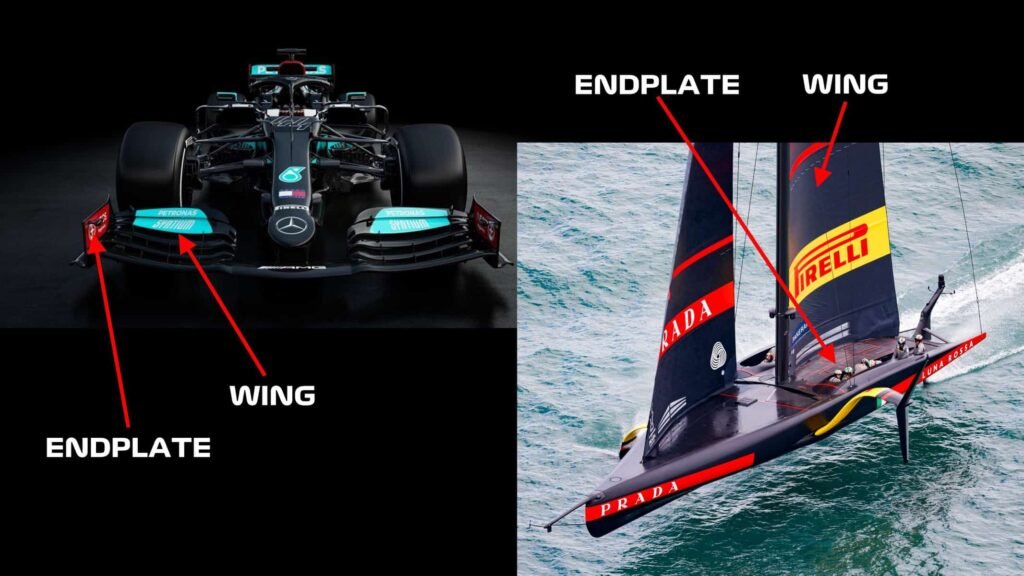
The line between motorsport and high-performance boating is progressively converging; aerodynamics, hydrodynamics, composite materials, and energy management are being developed considering the same physical problem: how to control a fluid as efficiently as possible to generate speed, stability, and range.
Three emblematic cases fit into this context: INEOS Britannia, Alinghi Red Bull Racing and Ferrari Hypersail which describe three different levels of integration between motorsport and nautical engineering skills.
INEOS Britannia
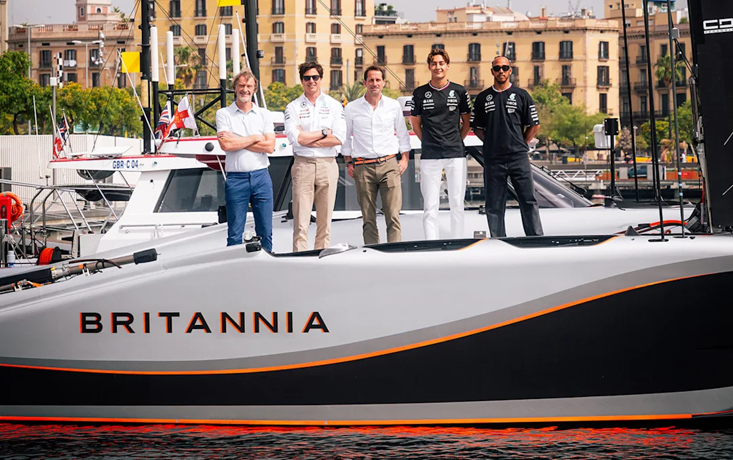
The case between INEOS Britannia and Mercedes-AMG Petronas Formula One Team represents one of the most structured examples of engineering contamination between Formula 1 and racing sailing.
In 2025, following the split between INEOS Britannia and Sir Ben Ainslie, which culminated in the latter’s departure from the team and the birth of rival Athena Racing, the technical collaboration with Mercedes also ended, interrupting a flow of technology transfer that had defined the project’s identity.
The partnership, active since 2019, had brought up to around thirty Mercedes engineers directly involved in the sailing programme, with an integrated structure between the Brackley headquarters and the sailing team.
The contribution of the Mercedes-AMG F1 Applied Science division focused on four fundamental pillars: advanced CFD simulation with multi-phase models capable of simultaneously representing air and water, the typical Formula 1 development methodology based on extremely rapid iterative cycles and continuous correlation between simulation and real tests, the development of dynamic control systems for foil management and finally the adoption of production standards derived from F1, with extremely low geometric and structural tolerances applied to nautical components.
A key element of the project was the construction of the T6 test boat, an experimental platform of approximately 40 feet used as the nautical equivalent of a Formula 1 “mule car”, designed to validate CFD models, control systems and structural components prior to integration on the final AC75.
The result was a collaborative model in which the engineering culture of Formula 1 was not simply transferred but integrated as the complete operating system of nautical design.
Alinghi Red Bull Racing
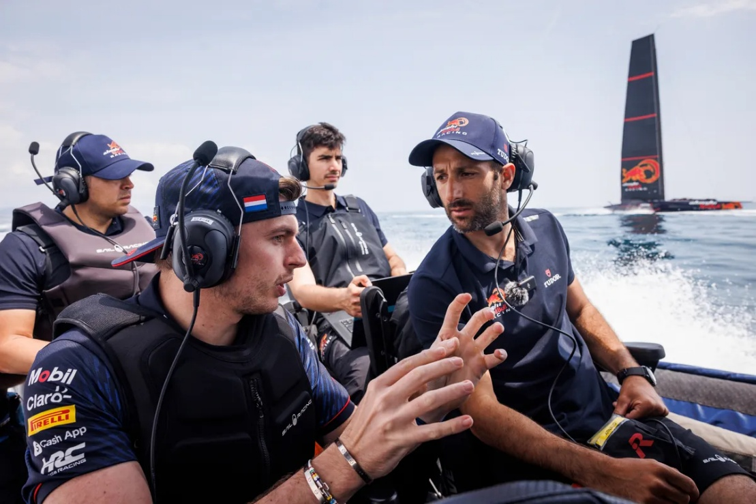
A related but equally significant approach is that between Alinghi Red Bull Racing and Red Bull Racing, supported by the technology infrastructure of Red Bull Advanced Technologies.
In this case, the transfer does not concern individual technologies, but an entire methodological architecture derived from Formula 1.
The main contribution concerns the use of state-of-the-art CFD pipelines, already used in the aerodynamic development of Red Bull single-seaters, adapted to the simulation of fluid-structural interactions between air and water in foil systems. The engineering focus is on complex phenomena such as flow separation, vortex instability, and transitions between laminar and turbulent regimes under variable conditions, typical of high-speed navigation.
Added to this is a second, even more relevant level, linked to control systems and real-time data management. Formula 1-developed expertise in high-frequency telemetry, predictive processing, and dynamic control systems is being transferred to sailing to anticipate boat behavior on extremely small-time scales.
In this way, the AC75 becomes a reactive system governed by predictive models, in which attitude and foil regulation occur before physical variation even fully manifests.
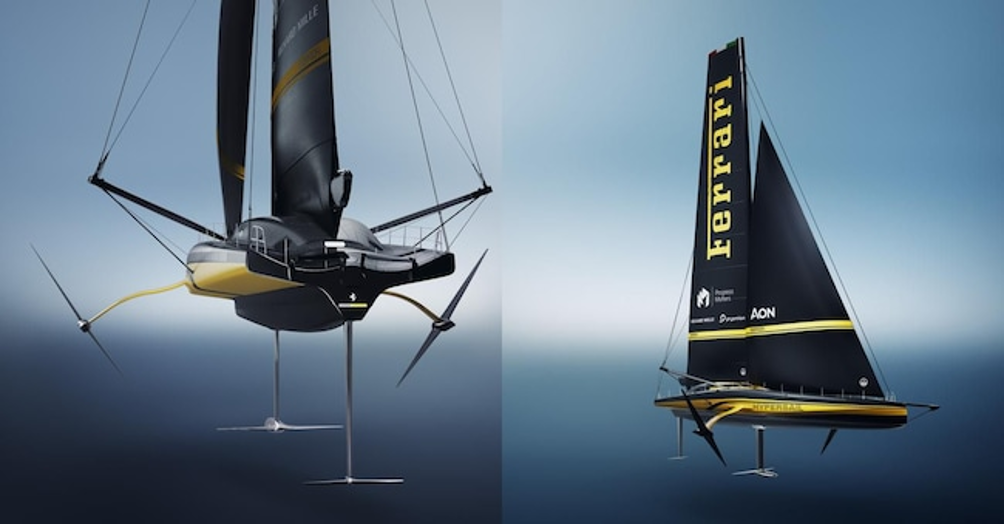
Ferrari Hypersail
Ferrari’s approach, however, is different, as it does not enter the partnership system but builds a radical proprietary project.
The Ferrari Hypersail program, announced in 2025, involves the development of a monohull ocean yacht of approximately 100 feet (about 30 meters), designed not to compete within an existing class but to redefine the limits of navigation. Ferrari has in fact positioned the project beyond the regulatory constraints of the America’s Cup, making it an autonomous experimental platform.
The project is led by designer Guillaume Verdier, who is among the most influential in the design of next-generation racing yachts. The operational and validation phase was initially entrusted to Giovanni Soldini, with subsequent transfer to Enrico Voltolini, responsible for electronic integration, tuning, and performance validation in real-world navigation conditions, culminating on April 21st with the presentation of the official livery during Milan Design Week.
Hypersail’s technical architecture is based on an advanced hybrid system that combines load-bearing foils and a tilting keel, creating a three-point stabilization configuration in which one of the foils is directly integrated with the keel itself, while the other control points are represented by the rudder and the second lateral foil. This scheme represents a synthesis between the structural logics of ocean IMOCAs and the aerodynamic efficiency of AC75s, but extends their operational domain towards real ocean conditions and no longer controlled racing.
The central problem is no longer just lift generation, but dynamic attitude control over long time intervals and under varying navigation conditions. Unlike the America’s Cup, in fact, Hypersail must maintain its flight regime for thousands of miles, continuously managing load variations, wave impacts (slamming), foil ventilation and possible cavitation phenomena.
A further innovation element is the goal of total energy autonomy: The vessel is designed to operate without any traditional fuel in operation, relying on an integrated system composed of high-efficiency solar panels distributed on deck and walled, hydrodynamic energy recovery systems and high-energy density batteries. This architecture derives directly from the expertise developed in the Ferrari Hypercar field, particularly in advanced electrical system management, thermal control, and charge and discharge cycle optimization.
As with INEOS Brittania and Alinghi Red Bull Racing, the structure of the vehicle follows the philosophy of composite materials derived from Formula 1, with ultra-high modulus carbon fibres and low density sandwich constructions, designed to withstand extreme loads while maintaining high structural rigidity.
Three approaches, a single evolutionary trajectory
The comparison between the three cases highlights three distinct levels of integration between motorsport and the nautical sector: INEOS Britannia represents the direct transfer of the Formula 1 method within a regulated system, Alinghi Red Bull Racing embodies the transposition of the entire F1 engineering and digital ecosystem into high-performance sailing, while Ferrari Hypersailis positioned on an even different level, that of absolute experimentation beyond existing classes.
The bottom line is that motorsport is no longer just an inspiration for boating: it has become a transferable engineering infrastructure.
At the same time, the sea is transforming into an extreme laboratory for testing energy autonomy systems, coupled fluid air–water control, and structural architectures bordering on applied physics.
The bottom line is that motorsport is no longer just an inspiration for boating as two sports are transforming into a single technological ecosystem.