
In modern motorsport — as well as in more extreme sailing competitions — speed is not just a matter of engine or favorable wind. It is an invisible battle, fought between a fluid medium (air or water) and a vehicle designed to pass through it as efficiently as possible.
Whether it’s a Formula 1 car, a hypercar, or an AC75 monohull, the principle is the same: control flow, reduce drag, and turn the surrounding fluid into an ally.
Although air and water are both fluid, they have fundamental differences in density (water is ~800 times denser than air), dynamic viscosity, and compressibility.
Aerodynamics and hydrodynamics, however, are not separate disciplines: they are two applications of the same fluid mechanics, governed by common quantities such as pressure distributions and boundary layer developments.
When a vehicle moves, it generates a fluid field characterized by:
– Drag, which is not a single force but the sum of frictional (or surface) drag, related to the boundary layer adhering to the surface, form (or pressure) drag, due to flow separation and induced drag, related to the generation of lift.
For example, in Formula 1, approximately 60–70% of the total drag comes from pressure and vortex phenomena (rear wing, open wheels).
– Downforce, which results from a pressure difference between the surfaces.
In F1, downforce is generated to increase the vertical load on the tyres, while in sports racing, aerodynamic (sail) and hydrodynamic (foil) lift are generated.
– Turbulence, which represents energy dissipation, increases drag and directly influences vehicle stability.
Consider how critical turbulent wake management is in F1 and the regulatory measures to reduce “dirty air”.
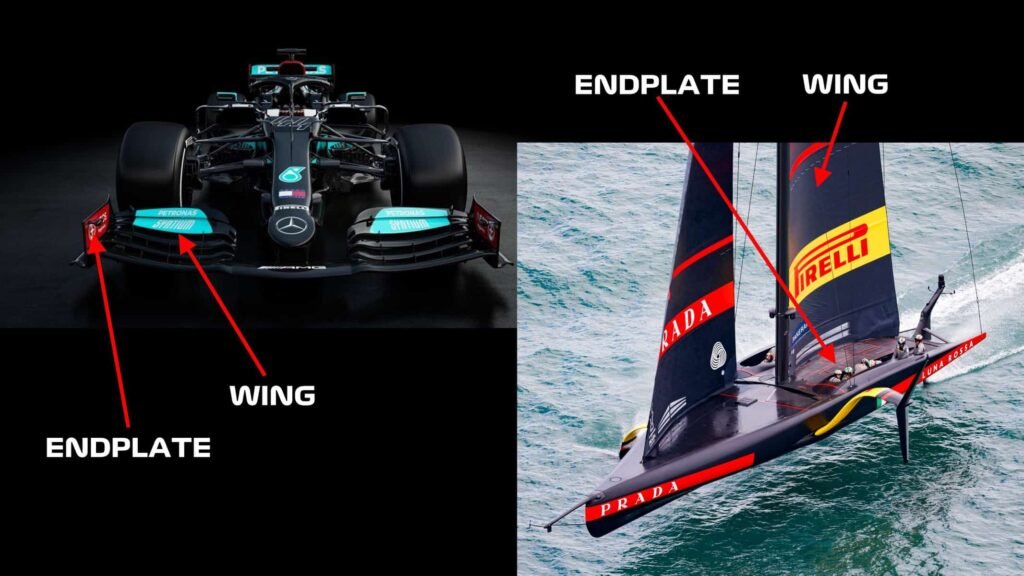
Shared domains: Manipulation and contact with fluid
In both high-performance racing and racing, fluid (air or water) is manipulated to obtain useful force with minimal energy penalty:
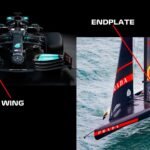
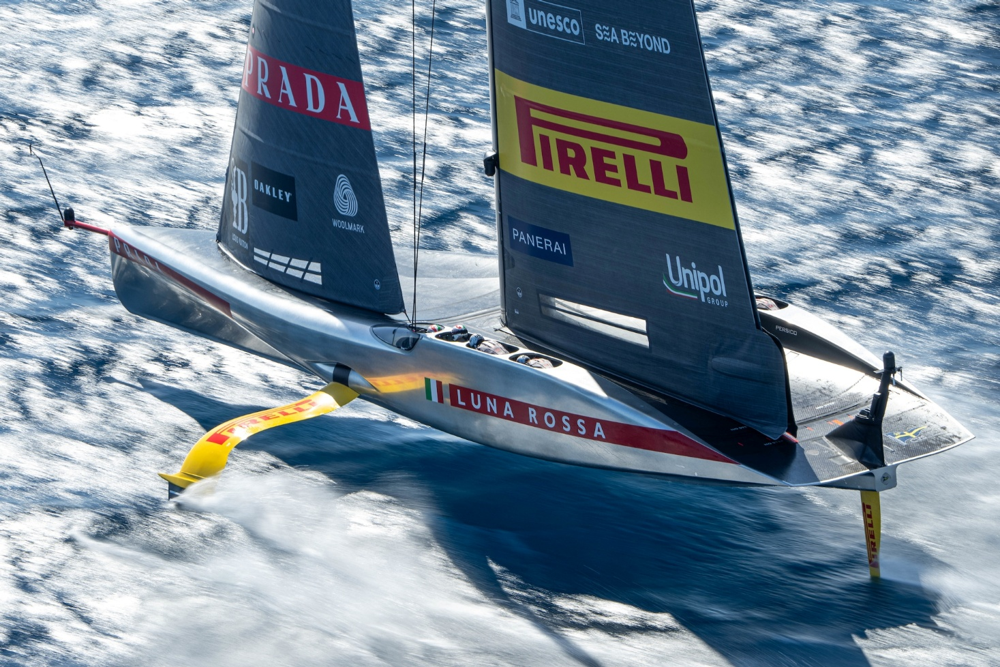
The modern America’s Cup AC75s do not sail but actually fly on water thanks to foils, hydrodynamic profiles designed with a cross-section similar to an aircraft wing, active angle of attack control and ultra-high elastic modulus materials.
As speed increases, lift increases, the hull lifts with the result of the downing of the viscous drag and speeds above 50 knots (~93 km/h).
The concept is strikingly similar to the ground effect: the car floor creates Venturi channels, or variable-section ducts in which the narrowing of the passage forces local acceleration on the fluid.
According to Bernoulli’s principle, an increase in flow velocity corresponds to a decrease in static pressure. Under the car, the air is then accelerated in a controlled manner through the shaped bottom and tunnels, generating a low pressure zone that “sucks” the car towards the ground. The result is high downforce with a much more efficient load/drag ratio than traditional wings, hence the concept of relatively “free” downforce.
Furthermore, in terms of functional equivalence for fluid contact, both pneumatic and foil transform physical forces into performance.
The tire works by controlled deformation, typically in a narrow thermal window characterized by progressive degradation.
In the nautical world, however, the foil and consequently the hull generate lift through flow, are subject to cavitation (formation of steam at low pressure) and consequent sudden loss of efficiency.
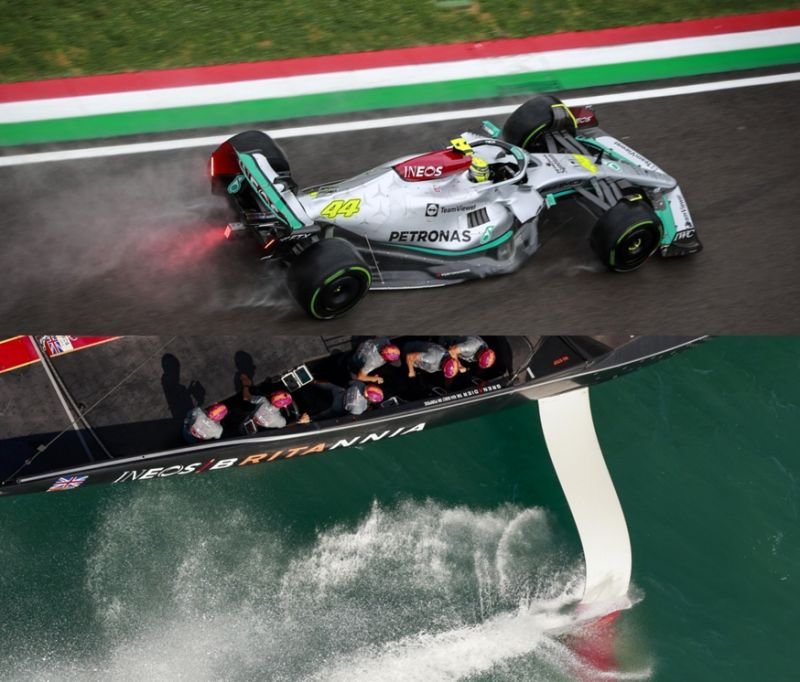
CFDs and materials
Computational Fluid Dynamics (CFD) allows to: simulate complex three-dimensional flows, analyzevortices, separations and wakes but above all predict fluid-structure interactions:
In the motorsport field, simulations are transient (variable time), use advanced turbulence models (LES, DES) and are enriched thanks to integration with wind tunnel data.
In the nautical field, however, the simulations are coupled air + water, characterised by free surface modelling (waves) and in-depth study of cavitation on foils.
In terms of materials, a common language is also spoken between the two sports domains: carbon fiber is the dominant material thanks to its very high stiffness-to-weight ratio, the ability to orient the fibers (controlled anisotropy), and high fatigue strength.
In both motorsport and high-performance boating, modern structures use prepreg (pre-impregnated resin fibers), autoclave curing (controlled curing), and honeycomb or foam core sandwiches.
In conclusion, it is clear that Formula 1 and America’s Cup are extreme laboratories of engineering: the type of fluid, air or water, changes, but the laws of physics remain unchanged and the design tools that allow margins to be played on invisible details are the same.
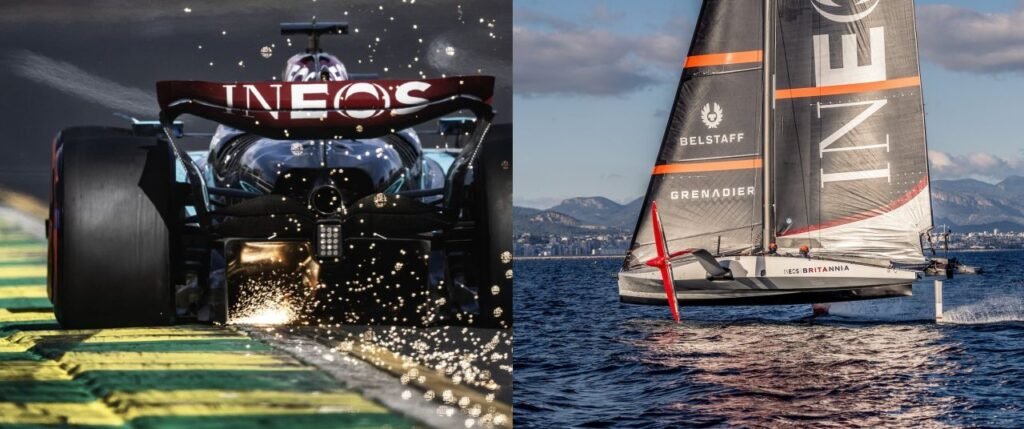
In the second part of this short column on the technological convergence between motorsport and high-performance racing, we will analyze three examples in technical and design detail: Mercedes-AMG Petronas Formula One Team with INEOS Britannia, Alinghi Red Bull Racing, and Red Bull Racing F1, and the Ferrari Hypersail project.